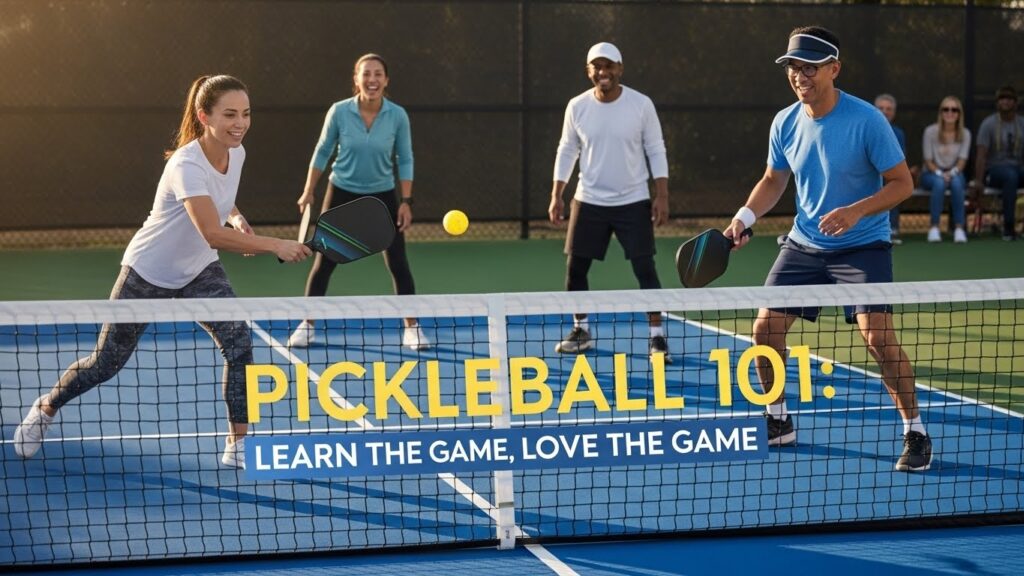
If you’ve noticed a new sport taking over local parks and community centres, you’re not alone. Pickleball, a game that combines elements of tennis, badminton, and ping-pong, is one of the fastest-growing sports in the United States. It’s an easy-to-learn, highly social, and surprisingly addictive game that people of all ages and fitness levels can enjoy.
A Brief History of Pickleball
The story of pickleball begins in the summer of 1965 on Bainbridge Island, Washington. Three fathers—Joel Pritchard, Bill Bell, and Barney McCallum—returned from a game of golf to find their families bored. They decided to invent a new game using an old badminton court, ping-pong paddles, and a perforated plastic ball.
As they developed the rules, their goal was to create a game that the whole family could play together. The name “pickleball” has a couple of origin stories. One popular theory is that it was named after the Pritchards’ family dog, Pickles, who would chase the ball and run off with it. Another version says the name came from the term “pickle boat,” which refers to the last boat to finish a race, often crewed by a random assortment of rowers—similar to how pickleball combines elements from different sports. Regardless of its origin, the name stuck, and the game quickly spread beyond their backyards.
The Essential Rules of the Game
Pickleball can be played as either singles (one-on-one) or doubles (two-on-two), with doubles being the more common format. The game is played to 11 points, and you must win by at least two points. Here are the fundamental rules you need to know to get started.
Serving
The serve is a crucial part of the game. It must be made underhand, with the paddle contacting the ball below the waist. The server stands behind the baseline and hits the ball diagonally across the court into the opponent’s service area. Only the serving team can score points.
The Two-Bounce Rule
After the serve, the receiving team must let the ball bounce once before returning it. Then, the serving team must also let the return bounce once before they can hit it. After these two bounces have occurred (one on each side), players are allowed to volley the ball—that is, hit it out of the air before it bounces. This rule is designed to encourage longer rallies and prevent a team from rushing the net immediately after the serve.
The Non-Volley Zone (The “Kitchen”)
One of the most unique features of pickleball is the non-volley zone, affectionately known as “the kitchen.” This is the 7-foot area on either side of the net. Players are not allowed to volley the ball while standing inside the kitchen. This rule prevents players from smashing the ball at close range and promotes a more strategic, dink-heavy game near the net. You can step into the kitchen to hit a ball that has already bounced, but you must step back out before you can hit a volley.
Getting the Right Equipment
One of the best things about pickleball is that you don’t need a lot of expensive gear to start playing. Here’s a breakdown of the essential equipment.
- The Paddle: Pickleball paddles are larger than ping-pong paddles but smaller than tennis racquets. They are typically made from lightweight composite materials like graphite, fibreglass, or carbon fibre. When choosing your first paddle, look for one that feels comfortable in your hand in terms of weight and grip size.
- The Ball: Pickleball balls are made of plastic and have holes, similar to a wiffle ball. There are two main types: indoor and outdoor. Outdoor balls are harder, heavier, and have smaller holes to better withstand wind and rougher surfaces. Indoor balls are softer and have larger holes.
- The Net: A standard pickleball net is 36 inches high at the sidelines and 34 inches high in the middle. Many tennis courts are being converted for pickleball, and portable nets are also widely available, making it easy to set up a game almost anywhere.
Understanding the Playing Area
A pickleball court is rectangular, measuring 44 feet long and 20 feet wide—the same dimensions as a doubles badminton court. The court is divided into several distinct areas that are important to understand for gameplay.
- The Sidelines and Baselines: These lines mark the outer boundaries of the court.
- The Centerline: This line divides the court into two halves on each side of the net, creating the service courts.
- The Non-Volley Zone (Kitchen): As mentioned earlier, this is the 7-foot area on both sides of the net. The line marking the edge of the kitchen is part of the kitchen itself.
The compact size of the court means there’s less ground to cover, making it a great option for players who may not have the mobility for a larger court sport like tennis.
Basic Strategies for Beginners
While pickleball is easy to learn, mastering it takes practice. Here are a few beginner-friendly strategies to help you play more effectively from your first game.
- Get to the Net: After the two-bounce rule is satisfied, try to move up to the edge of the non-volley zone. This position gives you the best chance to control the rally and put pressure on your opponents.
- Master the Dink: A dink is a soft shot that arcs just over the net and lands in your opponent’s kitchen. It’s a crucial shot that forces your opponents to hit an upward, less aggressive return.
- Keep Your Opponents Back: If your opponents are at the net, try hitting a deep “third shot drop” or a lob over their heads to push them back toward the baseline. This creates space and can disrupt their positioning.
- Patience is Key: Many points in pickleball are won by outlasting your opponent in a dink rally. Stay patient, focus on making consistent shots, and wait for your opponent to make a mistake. Even professional players like Genie Bouchard emphasise the importance of strategy and patience over pure power.
The Health and Social Benefits
Pickleball offers more than just a fun way to pass the time; it comes with significant health and social perks.
- Improved Physical Health: The sport provides a great cardiovascular workout, improving heart health, agility, and balance. The constant movement, quick direction changes, and swinging of the paddle help build strength and endurance.
- Low-Impact Exercise: Because the court is small and the game involves less running than tennis, it’s easier on the joints. This makes it an ideal sport for people of all ages, including older adults or those recovering from injuries.
- Mental Sharpness: Pickleball requires strategy and quick thinking. Anticipating your opponent’s moves and planning your shots helps keep your mind sharp.
- Strong Social Connections: Pickleball is an incredibly social game. The proximity of players and the friendly nature of the community make it easy to meet new people. Courts are often filled with players rotating in and out of games, creating a welcoming and inclusive atmosphere.
Find Your Court and Start Playing
The growing popularity of pickleball means that courts are becoming more accessible. Here are a few places you can look to find a game:
- Local Parks and Recreation Centres: Many community centres and public parks now have dedicated pickleball courts or have lined their tennis courts for dual use.
- Fitness Clubs and Gyms: Larger gyms and athletic clubs often offer indoor pickleball courts and may even host leagues or clinics.
Conclusion
Pickleball is a sport that truly offers something for everyone. It’s a game that is easy to pick up but offers enough depth and strategy to keep you engaged for years to come. Whether you’re looking for a new hobby, a way to stay active, or a community to connect with, pickleball is an excellent choice. So, grab a paddle, find a court, and give it a try. You might just discover your new favourite sport. The friendly community and exciting gameplay are waiting for you.