Operating a crane is a profession that combines immense responsibility with unique skill. These powerful machines are essential to modern construction, lifting and placing materials with a precision that seems to defy gravity. Becoming the person in control of that power is not a simple task. It requires dedicated training, rigorous testing, and an unwavering commitment to safety.
A career as a certified crane operator is both challenging and rewarding, but the path to certification is structured and demanding. For anyone considering this field, understanding the journey is the first step. Let’s break down what it truly takes to get certified and earn a place in the operator’s seat.
Understanding the Path to Certification
Becoming a qualified crane operator involves a combination of formal education, practical experience, and successful completion of standardized examinations. The process is designed to ensure that every certified individual possesses the knowledge and ability to operate heavy machinery safely and efficiently.
Foundational Requirements
Before you can begin specialized training, there are some basic prerequisites. Most programs require candidates to be at least 18 years old and have a high school diploma or its equivalent. Good physical health is also essential. Operators need solid depth perception, good coordination, and the ability to work at heights without issue. A physical examination is often part of the initial screening process to confirm a candidate’s fitness for the job.
Choosing a Training Program
The core of your journey will be a comprehensive training program. These programs are offered by vocational schools, industry unions, and private training organizations. A quality program covers two critical areas: classroom instruction and hands-on practice.
The in-class portion focuses on the theoretical knowledge every operator must master. This includes learning about crane types and components, understanding load charts, mastering rigging techniques, and studying safety regulations and standards. You will learn the physics behind lifts and how to calculate load weights to prevent accidents.
Mastering the Machine: Hands-On Experience
Theoretical knowledge is vital, but nothing can replace practical experience. The hands-on part of your training is where you learn to apply what you’ve studied in a real-world setting.
Supervised Practical Training
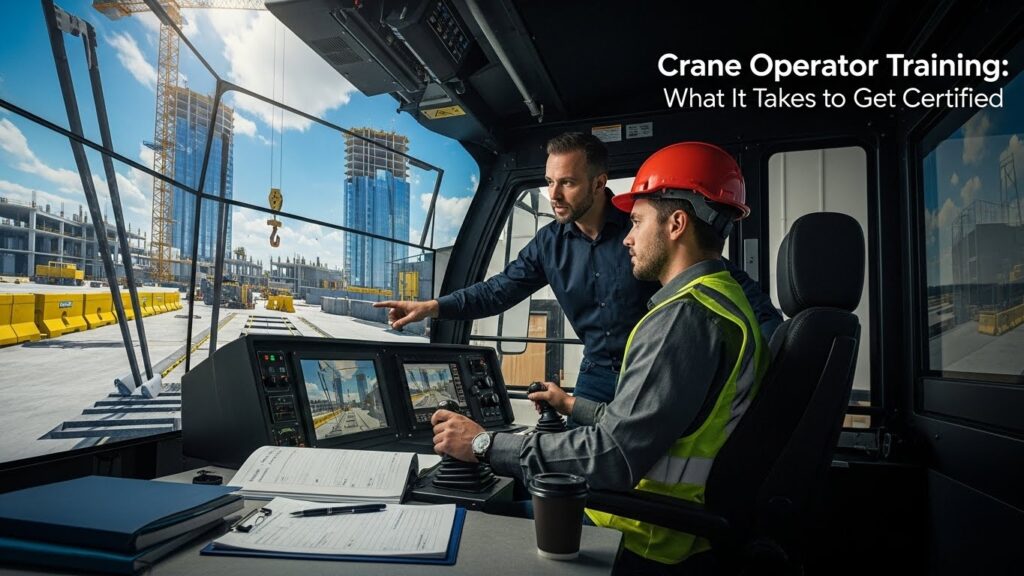
Under the watchful eye of an experienced instructor, you will get your first feel for the controls. This supervised training starts with basic maneuvers and gradually progresses to more complex tasks. You will learn how to properly inspect the equipment before use, execute smooth and steady lifts, and communicate effectively with the ground crew using standard hand signals. This practical application is crucial for building the confidence and muscle memory needed to handle these complex machines. Different job sites have unique demands; for example, operating a rough terrain crane in Utah might present different challenges than operating a tower crane in a dense city. Training prepares you for these varied scenarios.
The Final Step: Certification Exams
After completing your training, the final hurdle is passing the certification exams. The most recognized certification in the United States is provided by the National Commission for the Certification of Crane Operators (NCCCO).
Written and Practical Examinations
To earn certification, you must pass both a written test and a practical test. The written exam is a multiple-choice test that covers the core knowledge you learned in the classroom. There are different exams for various types of cranes, so you will test for the specific equipment you plan to operate.
The practical exam is a hands-on performance test. An examiner will ask you to perform a series of tasks with a crane, such as lifting a load through a designated course and placing it in a specific spot. This test evaluates your operational skill, your adherence to safety procedures, and your ability to control the machine with precision.
A career as a certified crane operator offers a unique opportunity to play a pivotal role in building our communities. The path requires dedication, but for those who complete it, it leads to a profession built on skill, precision, and the highest standards of safety.